Dental Microscopes vs Loupes
An honest comparison from a general dentist who uses both.
More and more general dentists are using the dental microscope for their bread-and-butter restorative dentistry.
But why? Aren’t loupes and a headlight more than enough for crowns and fillings?
I use both microscopes and loupes every day, and I’ve done so for the past 10 years.
In this article, I want to give you my honest take on why dental microscopes, long thought of as an endodontic tool, are beginning to challenge loupes as the go-to optical instrument for restorative dentists.
Let’s break this battle of the optics into 9 duels, each of which will help you understand where loupes may be more useful than the microscope, and where the microscope clearly wins.
Before we do that, let's familiarize ourselves with the specific equipment I'll be using for my comparisons in the article.
Magnification and Illumination Equipment Referenced in the Article:

Workhorse Scope #1: Zumax OMS 2050 R5 - entry level microscope. I've modded it with a 50 mm extender to make it ideal for restorative dentistry. You can't see them, but I placed about 12 stick-on 1 oz wheel weights on the back of the scope to counter balance the extended oculars. I don't know if this adhesive is ever coming off - do so at your own risk

Workhorse Loupes: The 4.5x prismatic loupes from Enova Illumination are my current favourites. You can see there's an attachment for a loupe-mounted headlight, but I actually prefer a head-mounted illumination system when I can't use a microscope.

Workhorse Scope #2: Zumax OMS 2380 R2 - middle tier microscope. I've added a second ergo wedge (there is a 30 degree + beam splitter wedge attached the to the body, and then a 45 degree stand alone wedge on top of that before the rotation ring and the oculars themselves)

Workhorse Headlight: I've tried a lot of surgical headlights. The Qubit Pro is by far my favourite due to its balance between high performance and affordability. It also has a curing filter, which even the higher end surgical lights don't have.
Duel #1: Perspective
Loupes offer a flexible perspective.
You probably aren’t even aware of this, because it’s how you’ve experienced the world since you were born. When you move your head, your perspective moves with it, because it starts at your eyes.
Practically speaking, this means you can tilt your neck a little while prepping a crown to improve your view, and we do this all the time as restorative dentists.
Microscopes, on the other hand, have a fixed perspective. Unlike loupes, that perspective starts at the microscope’s objective lens, not at your eyes. If you’re relying on the microscope to see, tilting your neck does nothing to change your view. The only way to change what you see through the microscope is to physically move the microscope itself.
In other words, your perspective is now independent of your eye position and fixed instead to the position of the scope.
At first glance, you might think the microscope is losing this duel. Not so fast.
Because of how dental microscopes are designed, this shift in perspective from your eyes to the objective lens actually creates some unique advantages that no loupe can offer. No, not even ergo loupes (which I don't own, by the way - those imaged below are loaners!).


Duel #2: Ergonomics
That brings us to our second duel: ergonomics.
There is a principle in the dental microscope world called the ergonomic offset. This is simply the distance between where your viewpoint begins and where your eyes physically are.
With loupes, that offset is basically zero. With a microscope, it can be substantial, because the oculars extend so far out from the body of the scope.

With the right ergonomic accessories, a microscope can be set up so that the dentist sits back comfortably while their viewpoint begins directly above the patient’s oral cavity.
And that is a huge advantage.
Having your perspective start directly above the mouth dramatically improves direct vision of the upper arch, while also making indirect vision of the lower arch far more practical than it ever was with loupes. Without this ergonomic offset, a dentist’s viewpoint usually begins from behind the patient, or from the side of the patient if they want to stay comfortable.
That position works reasonably well for direct vision of the lower arch and indirect vision of the upper arch. But it becomes very restrictive when you want to introduce a mirror during a lower crown prep, or when you need clear direct visualization of the upper arch for something like rubber dam clamp placement or a final impression.
This is why dentists hunch over and crane their necks so often. They’re trying to improve their vantage point.

Notice how I have direct vision of the upper arch while still sitting very comfortably. This is the ergonomic offset in action. As a restorative dentist with back or neck problems, it's a game changer - but you do have to take the time to become proficient with the microscope. More on that in a bit.
So while loupes offer a fluid perspective, the actual range of useful vantage points from a comfortable operator position is often limited.
The microscope has a fixed perspective, but it can be positioned to give you an excellent vantage point while preserving excellent ergonomics (as shown above).
One last note before moving on: microscopes are not just more ergonomic for your neck and back. They can also be more ergonomic for your eyes.
Looking through a microscope is a bit like looking out at the horizon through a nice pair of field binoculars. Your eyes can completely relax. They do not need to converge the way they do with loupes. The microscope handles that convergence for you.
Some people do not notice this much. But if your eyes feel tired after a long day in loupes, you probably will.
Duel #3: The Learning Curve
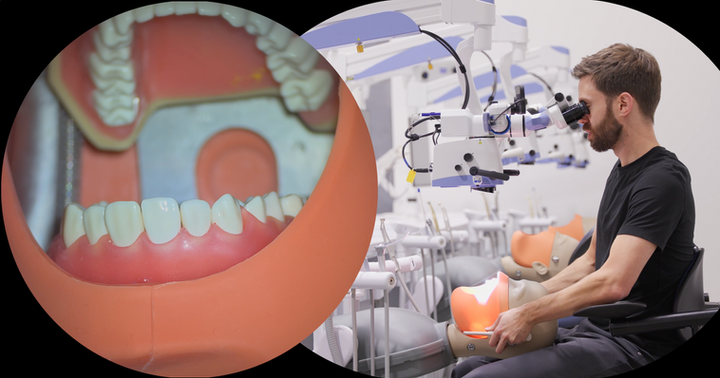
Now, all this talk of superior ergonomics can make the microscope sound like an answer from heaven for the general dentist with a sore back. But before you get too excited, one thing needs to be said: microscopes are harder to use at first.
You can have the most ergonomic microscope in the world, but if you do not know how to position it properly, you will not be any more comfortable. Early in the learning curve, microscopes are more demanding than loupes because you have to be constantly aware of positioning while also adapting to that fixed perspective we talked about earlier. That can absolutely lead to ergonomic compromises, especially if you are trying to learn the microscope without training.
But once you achieve true mastery with both systems, I actually believe the microscope becomes easier to use than loupes in many ways. And that brings us to the next three duels.

Duel #4: Magnification
Modern microscopes offer a flexible magnification range, and this is one of their biggest advantages.
If I need to place a rubber dam, I’ll stay around 3x magnification. If I need to find a calcified canal, I can turn it up to 12x. If I’m prepping teeth, I usually live around 5x to 7x.
I always have the right level of magnification at my fingertips. It’s a beautiful thing, and it makes dentistry much more enjoyable. Personally, I strongly prefer a manual continuous zoom system when it comes to magnification changers.
Older microscopes often had only four to six magnification steps. Newer scopes, like my Zumax OMS 2380 and OMS 2050, offer a continuous zoom range, which feels much faster and much more intuitive.
Duel #5: Photo and Video Documentation
Microscopes absolutely dominate when it comes to documentation.
Because an adapted or integrated camera can see virtually the same thing I see, I can capture incredibly detailed photos and videos with minimal interruption to my workflow. That is a big part of how I built my 125 000+ subscriber YouTube channel, in fact.
If you try to mount a camera to your loupes, on the other hand, the video is usually shaky and often unusable. And even when it works, the quality is nowhere near what is possible through a microscope.
That is because head-mounted camera systems cannot take advantage of the optical magnification of your loupes.
With microscopes, the camera is using the same glorious optics that your eyes are using. That is why the photo and video quality can be so incredible for those who master the microscope.

Duel #6: Illumination
Microscopes also offer far better illumination than the typical loupe-and-headlight setup.
Some of that advantage comes from the higher-powered LEDs found in modern scopes. But the more important benefit is how the light is delivered.
In a microscope, the illumination axis is aligned parallel to the optical axis. In simple terms, the light travels in the same direction as your view.
That matters clinically because it eliminates shadows and allows you to see down tiny dark holes with remarkable clarity.
Most loupe mounted lights are not positioned parallel to the loupe barrels, although there are a few exceptions (see below).

Enova Illumination sent me an Axis Elite system to test out. I was impressed! I still prefer my Qubit Pro because of the LED output, but this was the closest I've ever seen a loupe mounted head light get to being truly co-axial.

You can see they use a link system to allow the light to be positioned wherever you'd like. I'd like to see the links even longer for dentists who have a larger nose, which could prevent the light from being situated co-axially.
Duel #7: Cost
This is one duel that loupes win easily. Dental microscopes are not cheap.
Even though increased competition between manufacturers is bringing prices down, microscopes are still much more expensive than loupes. And if you do not have room for a mobile stand, you also have to think about the cost of mounting.
One silver lining is that lower-tier microscopes from reputable brands are often among the best choices for general dentists.
Personally, I would never choose a microscope because it has magnetic brakes, autofocus, or motorized zoom. Features like that would actually slow me down in restorative dentistry.
That is one reason I far prefer simpler, more affordable scopes like the Zumax OMS 2050. For my work as a restorative dentist, a scope like that serves me far better than many more expensive options (full review below).
Duel #8: Field of View
Let’s talk about field of view.
The first time you look through a high-quality operating microscope, it can feel like there is a movie theatre inside the eyepieces. It is a striking experience.
Part of that impression comes from the fact that the optical pathway in a microscope can offer roughly 50% more viewing area than expanded-field loupe barrels.
Now, when I say field of view here, I do not mean how much of the mouth you can see clinically. I mean the physical size of the image being presented to your eyes.
Think of it this way: if your loupes and your microscope are both set to 3x magnification, you may be looking at the exact same clinical image. But the microscope can project that image larger, and often with better resolution.
It is a bit like watching the game on a 50-inch 4K TV instead of a 40-inch Full HD TV. Same image — just larger and more detailed.
Duel #9: Practicality
With all that said, there are absolutely situations where microscopes are less practical.
If you work out of two or three different offices, a high-quality pair of loupes and a headlight may be the obvious choice.
It is also hard to justify a microscope if you simply do not have the time or willingness to learn how to use it properly.
And this is really the point: loupes are easier to adopt. They are portable, familiar, and practical. The microscope, by contrast, asks more of you upfront.
But if you are willing to climb that learning curve, the payoff can be enormous.
If you want to shorten that learning curve, I have put together a comprehensive online course on exactly that. And if you would rather start with free resources, you can find them at masterthemicroscope.com.
Final Thoughts
Learning to use loupes is a bit like learning to ride horseback after years of walking barefoot. It is relatively easy to learn, and it will absolutely help you move faster.
Learning the microscope, on the other hand, is like trading that horse in for a dragon.
Not everyone is willing to learn how to fly a dragon.
But those who do gain access to advantages that people on the ground simply never will.
-Michael

If you'd like to see the microscope in action on a real patient, check out this crown prep under the microscope.